
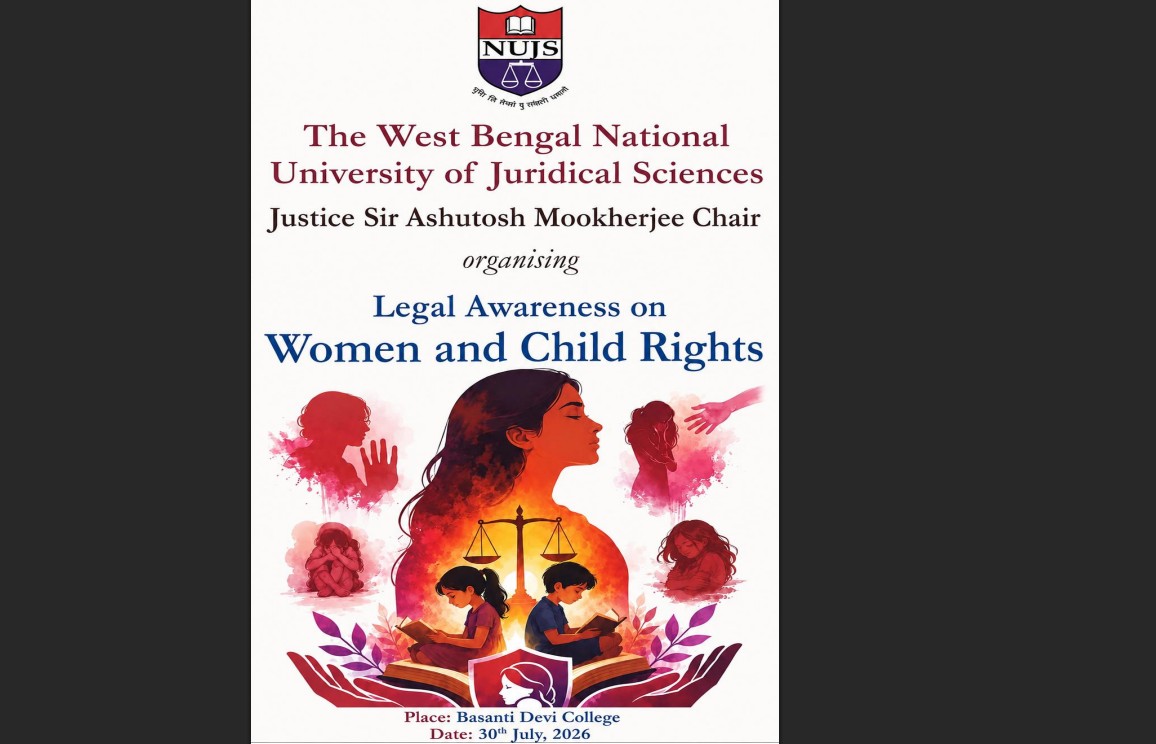
On July 30th, 2026 Justice (Sir) Ashutosh Mookherjee chair of the ‘West Bengal National University of Juridical Sciences’ (WBNUJS), organized a legal awareness programme on Women and Child Rights law, at the campus of Basanti Devi College, one of a renowned women’s college located in Rash Behari Avenue, Ballygunge, Kolkata- 700029.
Keeping in view about the importance of legal literacy among the young females, the programme was being organised with an aim of familiarizing the students of the women and child rights law given under both the international and Indian legal framework along with awaring the students about the available rights granted to them by both the constitution and other Indian legal statutes. The session primarily focused on empowering the students with the knowledge of key legislations and legal remedies granted in context of the vulnerable sections of the society i.e., women and children and highlighting the contemporary challenges faced by the latter, while encouraging the them to recognize their rights, responsibilities and role in promoting gender justice and child protection.
The programme started with a warm welcome by the principal of the college, Dr. Indrila Guha who showed her keen interest and encouragment on the awareness programme about women rights and told how necessary it is to understand the legal remedies given to us by the law. Next Miss Aatreyee, assistant professor of the Basanti Devi College, also welcomes the members of the said chair and urged the students on the importance of being aware about the available women and child rights granted by the law which could help them in future assert their rights correctly, assist others in accessing legal remedies and actively contribute to advancement of equality and justice.
The programme started with the brief introductory speech delivered by ‘Chair Professor Dr. Shachi Chakrabarty’, of Justice (Sir) Ashutosh Mookherjee chair at NUJS, explaining in a simple language and well-structured way various laws, legislations and important cases in context of women and child rights in order to help the students understand better and more clearly about the laws mentioned in various statutes. She started the event by quoting one of the most powerful lines of ‘Michelle Obama, the former First lady of the United States, which said , “There is no limit to what, we as woman, can accomplish” emphasising the need for woman empowerment and encouraging them to stand and fight for injustice wherever or whenever they experience in their life and promote justice and gender justice in the society. She had stated that it is important for the students to be aware of women rights it is important firstly to understand both the human rights and child rights because all the three rights are interrelated and cannot be read independently because child rights cannot be guaranteed in framework which diminishes women’s status and discriminates against women’s right. By stating the lines of Kofi Anan who served as the 7th UN Secretary-General who said “ There is a sacred duty to ensure the rights of the children”. The chair professor explained that in the Beijing Conference in China it was said that both women and children’s rights qualify under the purview of human rights and hence it’s important to see the women and child rights collectively under the human rights. Human rights of both women and children have a close connection between them because historically in our age-old patriarchal society women and children have been legally and socially marginalised and human rights framework is effective for analysis of this social and gender inequality and the rights of children and hence it is necessary that the students are aware of the same. She briefly gave the idea about the women and child rights discussed both in international law namely the ‘Universal Declaration of Human rights’ (UDHR), the UN Charter and the ‘Convention on Elimination of all kinds of discrimination against women’ (CEDAW) and in Indian perspective namely the constitution of India, criminal legislations like POCSO Act, Domestic Violence Act and others. She mentioned constitution is the backbone of all laws of the country and in that women and child rights are the core concept of constitutional concern. She continued by saying that there are various important articles in the constitution like Article 21 which talks about protection against the life and liberty where the bodily integrity and autonomy of an individual has been given a high importance and the need to protect the same which is necessary in context of women and crimes where a women’s dignity and self-respect should always be considered a priority while discussing any case. Similarly, there is Article 24 that prohibits and provides protection against child labour and child expolitation in any forms. The Chair professor also mentioned various important cases in order to familiarize the students about the practical application of law by the judiciary like the ‘Shayara Bano vs Union of India’1 which banned the inhuman practise of instant triple talaq in context of Muslim women. She also discussed the ‘Air India v Nargesh Meerza’2 case which challenged the discriminatory service regulations for female pilots, ‘Gita Hariharan v. Reserve Bank of India’3 case which struck down the gender-based discrimination on mother’s rights to natural guardianship to make the students understand the judicial interpretation of women rights. Thus, by delivering a detailed and structured explanation of all the relevant statutes, legislations along with some important case laws, the chair professor gave a concise idea to the students about the important of knowing and understanding women and child rights for us in order to be legally aware and active citizens of the country.
The next speech was delivered by Miss Kinkini Mukherjee, research assistant of the above mentioned chair, who discussed on the constitutional aspects of women and child rights along with certain important legislations on women’s issues. In context of the constitutional law, she discussed some important articles which is required for the students to know and understand the same. She spoke about Article 14 which states equality before the law or the equal protection of the laws within the country meaning thereby that no citizen of India shall be treated unequally in any aspect be it rights or access to justice. She further discussed about Article 15 which states that prohibition of discrimination based on grounds of religion, race, caste, sex or place of birth and Article 16 which provides for equality of opportunity in matters of public employment with this aim of awaring the students about their constitutional rights against discrimination and promoting equality and equal opportunities for all. In context of women rights, she discussed two acts, which is the ‘Dowry Prohibition Act’,1961 and the ‘Domestic Violence Act’, 2005. She explained that it is important to understand both the concepts of dowry and domestic violence not as a standalone concept but as interrelated. She pointed out that dowry demands is one of the significant causes of domestic violence as women become the victims of all forms of abuse be it physical, emotional, verbal, sexual or economical when the dowry expectations by the husband and the in-laws are not met or the amount given is considered insufficient. Such forms of violence and torture may include harassment,
intimidation, coercion, cruelty and, in extreme cases, dowry deaths. She mentioned the famous 1991 Supreme Court case of ‘Bhoora Singh vs State of UP’4 which convicted the husband and the in-laws for inflicting cruelty and torture on the wife because of unfulfillment of dowry demand which lead to her death. Drawing from the recent events, she also cited the infamous ‘Twisha Sharma’ murder case which occurred in the month of May 2026 where Twisha, a famous youtube influencer who was found dead in her in-laws residence citing that she was inflicted to mental and physical abuse and harassment for dowry demand. However, one of the common thing which happened in both these cases were that the families of the deceased were aware of the harsh situation that their child went through yet they chose to remain silent and didn’t report a single incident of physical abuse which ultimately lead to the death of the victim. Hence, by drawing lines from both these cases, she tried to explain the importance of reporting any kind of abuse or violence if they face or they have seen any of their closed ones facing the same by calling the National Commission for Women Helpline No. 14490 for domestic violence. Thus, it is important for reporting the cases of dowry or domestic violence cases because it enables timely legal intervention, holds perpetrators accountable and facilitates access to support services to the victims such as medical care, counselling and legal aid. It prevents the escalation of violence and saves the life of the women while promoting justice and social awareness.
The next talk was delivered by Miss Surupa Das, research assistant to the chair who familiarised the students with the criminal law framework safeguarding the rights of women and children in India. She started with laws built in context of child rights where she gave an overview of the ‘Protection of Children from Sexual Offences (POCSO)’ Act, 2012, highlighting it’s child friendly approach towards addressing sexual offences against children. She told that the POCSO Act is a gender neutral Act where both the boy and the girl child is treated equally and said any kinds of sexually assault against children or possesing any child pornographic material or showing the child the same or anyone having the knowledge about the same is punishable under Section 14 of the Act. She placed a special emphasis on Section 19, which mandates the reporting of offences under the Act, stressing that prompt reporting is essential to ensure the safety of the child, facilitate immediate intervention, and prevent further victimisation. She cited a recent case of Supreme court ‘AAA vs Linda Sema’5 which was decided on July 09, 2026 where the Supreme Court held the accused liable for failure of reporting of the case of a child victim being sexually assaulted in the school despite having knowledge and evidence of the same. Hence, by citing this case, she made the students aware of their responsibility to report suspected instances of abuse if they have the accurate
knowledge of the same and the legal consequences of failing to do so. Other relevant provisions of the Act were also discussed to provide a comprehensive understanding of the legal safeguards available to children. Next she explained the ‘Juvenile Justice (Care and Protection of Children)’ Act, 2015, where the concepts of ‘Children in Need of Care and Protection’ (CNCP) and ‘Children in Conflict with Law’ (CCL) were explained. She said that the CNCP children includes the missing, abandoned, mentally-ill, neglected children by the family, or working in any shops and vice-versa needs to be taken care and protected whereas the CCLs are the juveniles who commit an act considered as crime under the law. Most of the CCLs commit crime not out of their own will but due to parental issues, broken homes, financial conditions or influences from bad company and hence it is important for looking at both the categories of children as equal and they need the care and assistance of the adults in the society.
She also discussed briefly about the ‘Prohibition of Child Marriage Act’, 2006 (PCMA) were she said that a child marriage remains voidable at the option of the contracting party who was a child at the time of marriage under Section 3, while those involved in solemnising, promoting, or permitting such marriages are liable for punishment as per Sections 9, 10, and 11 of the Act. She further examined the major causes of child marriage, including poverty, gender discrimination, social customs, lack of education, and economic insecurity. She encouraged the students to recognise child marriage as a violation of children’s rights and to report such incidents to the appropriate authorities.
Hence, she emphasised that as a responsible citizen, there is a need for early reporting which enables the child welfare authorities to identify vulnerable children, provide institutional support, and ensure their protection, rehabilitation, and reintegration into the society. For that purose, she informed the students about the procedure of reporting in simple terms which includes that for reporting incidents involving child abuse, child sexual offences, trafficking, child marriage, or any form of exploitation, it may be reported in various ways like calling the Child Helpline number (1098), by approaching the nearest police station, or by dialling the emergency number 112 for immediate police assistance. In cases involving cyber offences against children, such as online grooming, cyberbullying, or circulation of child sexual abuse materials, complaints may be lodged through the National Cyber Crime Reporting Portal.
In context of women rights, she explained the offences of criminal intimidation, sexual harassment, voyeurism, and stalking, emphasising that these crimes may occur both physically and through digital or online platforms, causing significant psychological, emotional, and physical harm to women. She highlighted the legal remedies available to victims and stressed the importance of reporting such incidents at the earliest to prevent further victimisation and ensure timely legal action. She further informed the students about the Women’s Helpline (181) number as an immediate support service for women in distress and were also guided on the procedure for lodging complaints through the National Cyber Crime Reporting Portal in cases involving online harassment, cyberstalking, image-based abuse, or other cyber offences. Thus, step-by-step reporting process was briefly explained to encourage students to seek assistance without fear and to make effective use of the legal mechanisms available for their protection.
She also discussed the ‘Sexual Harassment of Women at Workplace (Prevention, Prohibition and Redressal)’ Act, 2013 (POSH Act) where she said about the necessity of the legislation as it ensures in providing a safe and dignified working environment for women. She also elaborated upon the complaint mechanism under Sections 9, 10, 11, 12, and 13, covering the procedure for filing complaints, conciliation, inquiry by the Internal Committee, interim reliefs, and the recommendations following the inquiry. By citing the recent 2025 case of ‘Sohail Malick vs Union of India’6 , which said that in a workplace if the accused works in a different department, the employer of the same must cooperate with the internal POSH committee at the aggrieved women’s workplace thus, ensuring a woman is not denied justice merely because the accused works in a different department thereby making the complaint procedure more accessible and women-centric. She encouraged the students to understand their rights and responsibilities under the Act and to contribute towards creating safe, inclusive, and gender-sensitive educational and professional spaces. She concluded by reiterating that legal awareness, timely reporting, and collective responsibility are indispensable for protecting the rights of women and children and fostering a culture of justice, equality, and accountability.
Lastly, the final speech was delivered by Assistant Professor Sampa Karmakar Singh, faculty co-ordinator of the Justice (Sir) Ashutosh Mookherjee chair, WBNUJS, who discussed on the issues of marriage and property rights which is essential in context of women and child rights in India. She began by explaining the significance of Article 25 of the constitution of India, which guarantees the right to freedom of religion while saying that perosnal laws and religious practices must be in harmony with the constititutional values of equality, dignity and justice. She explained that while ‘Prohibition of Child Marriage Act’, 2006 prescribes the legal minimum age of marriage as 21 years for men and 18 years of women, different personal laws prescribe varying ages for marriage. In context of child rights law, she focused on the legal definition of a child under various legislations, explaining that different statutes prescribe different age thresholds depending on the object and purpose of the law. Since the awareness programme date i.e., July 30th, 2026 also happened to be the ‘World Day Against Trafficking in Persons’ she discussed briefly on the concepts of human trafficking including child trafficking as well. She talked about Article 24 of the constitution which prohibits employment of children below the age of 14 years in hazardous occupations along with Section 143 of the
‘Bharatiya Nyaya Sanhita, 2023’. She discussed the meaning of trafficking which is the illegal recruitment, transportation, or harbouring of a person through force, fraud, deception, or coercion for the purpose of exploitationas. She mentioned that as per explanation (1) of Section 143 of BNS ‘exploitation’in context of trafficking includes ‘any act of physical exploitation or any form of sexual exploitation, slavery or practices similar to slavery, servitude, beggary or forced removal of organs’ and mentioned that the victims consent is immaterial in context of trafficking as said in explanation (2) of the same section. She also talked about Section 143 (4) which provides punishment for child trafficking which involves rigorous imprisonment for a term for ten years to life and shall also be liable to fine. She further explained that often child labour and child trafficking are interlinked i.e., children who are trafficked are mostly subjected to forced labour, domestic servitude and in cases of girls mostly they are being used as sex workers revealing the harsh reality of the same. Hence, she emphasised that the law seeks to protect children from exploitation and ensure their right to education, development and a safe childhood. The contribution of nobel laureate ‘Kailash Satyarthi’ and his ‘Bachpan Bachao Andolan’ was also mentioned to demonstrate how social movements have significantly contributed to combating child labour and child trafficking in India.
She also addressed the concept of bigamy and briefly explained its legal position under Indian law while discussing differences that exist across personal laws, including certain aspects of Muslim personal law and the distinctions between Sunni and Shia schools. The landmark judgment in ‘Shayara Bano v. Union of India’7 was referred to while explaining the judicial protection of women’s rights and the constitutional commitment towards gender justice. Students were encouraged to critically understand how legal reforms continue to evolve in response to changing societal needs.
In the next part, she focused on gender discrimination embedded within personal laws, particularly in matters relating to marriage, succession, and inheritance. She explained that despite differences among religious communities, a common concern across many personal law systems has been the historical discrimination faced by women. ‘The Hindu Succession Act’, 1956, was discussed as an example of legislative reform aimed at strengthening women’s inheritance rights. Next she discussed briefly about the 247th Law Commission Report titled “Sections 42 to 46 of the Indian Succession Act, 1925 – Proposal for Amendments,” which recommended removing gender-discriminatory and archaic provisions that denied Christian
mothers and women equal property inheritance rights. She said that how the above mentioned sections in law discriminated against females. She stressed the ongoing debate surrounding the Uniform Civil Code in the country to familiarise the students alongwith the contemporary legal and constitutional discussions concerning equality, secularism, and legal uniformity.
Towards the end, she also discussed briefly on the objectives of one of the most important initiative undertaken by the ‘Ministry of women & child development’, a Government of India which is the ‘Mission Vatsalya’ that aims for welfare of the children and to foster a sensitive, supportive, and synchronized ecosystem for children as they transit different ages and stages of their development.
Thus, the session followed through various inquisitive questions both from the students and faculties of the college to the resource persons and they answered appropriately. The interactive discussion enabled participants to understand better the relationship between constitutional principles and everyday social issues, thereby reinforcing the importance of legal awareness in achieving social justice and women’s empowerment.


 Users Today : 484
 Users Last 7 days : 3603
 Total Users : 33508