
Organised: Justice (Sir) Asutosh Mookherjee Chair
Venue: L.J.D. Public School, Falta, West Bengal
Date: 21 August, 2026
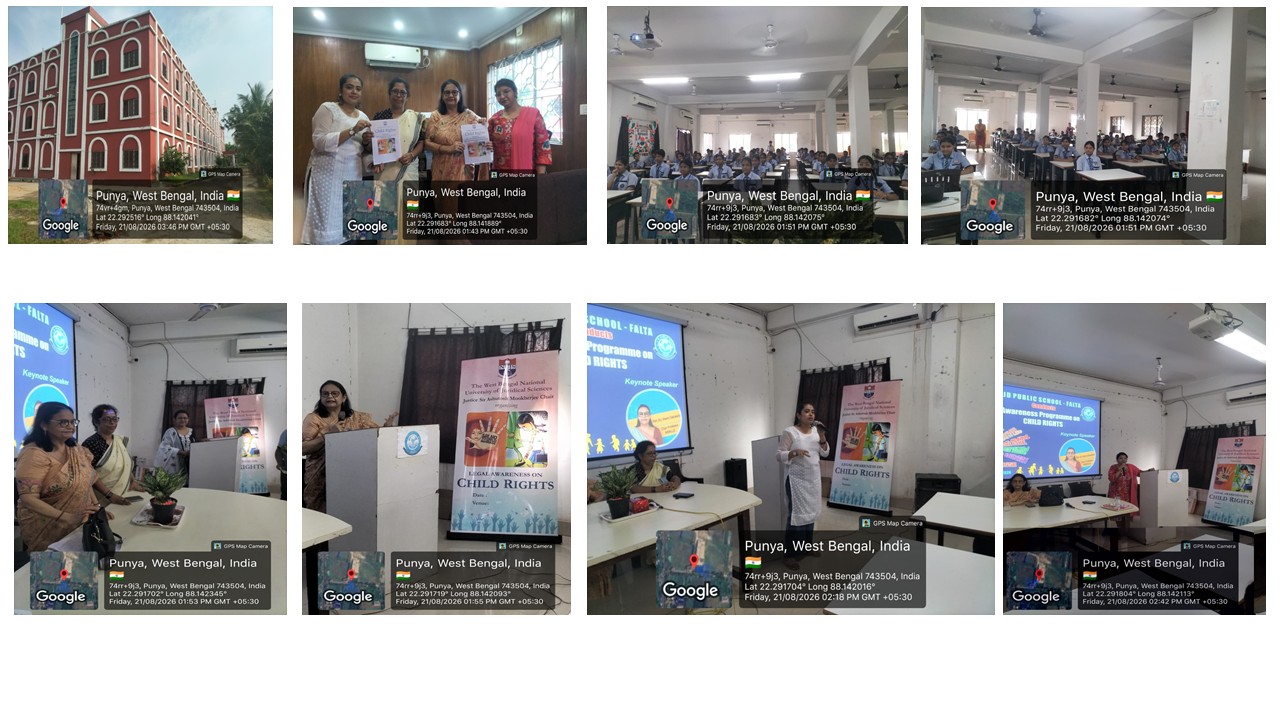
On 21 August 2026, the Justice (Sir) Asutosh Mookherjee chair held a legal awareness programme at L.J.D. Public School, Falta, South 24 Parganas, West Bengal. The Legal Awareness Programme was organised in furtherance of one of the objectives of the chair which is promoting constitutional values, legal literacy and social justice. One of the ways of achieving this objective is by conducting programmes relating to various facets of Bengal renaissance which includes crimes against women and children & gender justice.
Thus, keeping in align of promoting women and child rights, the programme enriched the students on the constitutional, criminal and various other related statutory laws relating to protection of child rights and also they were given a brief idea on child-related crime like child labor, child marriage, child trafficking while educating them on the effective realisation of their legal rights in order to recognise, report, prevent and safeguard against any violation of their rights.
The event started with a warm welcome introductory speech by Mrs. Sushmita Das, the Principal of L.J.D. Public School who addressed the students on the importance of legal awareness and education on child rights. The event followed with the speeches given by the chair members and ended with an interactive question & answer session where students asked various interesting questions on child rights which made the programme more enriching.
The introductory speech of the event was delivered by ‘Chair Professor Dr. Shachi Chakrabarty’ of Justice (Sir) Asutosh Mookherjee chair who explained in a very simple and easy language to the students about the available child rights laws present both in international and national perspectives along with a brief description about the relevant constitutional provisions, criminal statutory legislations for protection the children. She also emphasised that how crucial it is for the students to be legally aware of their rights given by the law and the effective realisation of the same against any violation of rights as well as follow their legal duties towards the development of the country. She started her speech by quoting the lines of the former Prime Minister of India, Pandit Jawaharlal Nehru, who said that, “Children are like buds in the garden and they should be carefully and lovingly nurtured”, thus emphasising the need for imparting students the knowledge about the legal rights and remedies. She then focused on ‘Right to Education’ mentioned in the constitution which provides for free and compulsory education for children between 6 to 14 years of age, including various other fundamental rights like Article 14 which is regarding equality before law, Article 15 which provides for no discrimination on gender-basis and others, Article 19 which provides freedom of speech and expression to the citizens as well a ‘Right to life’ and live with dignity as per Article 21 of the constitution, thus, discussing the development, participatory, cultural and social rights with emphasis that right comes with corresponding duties to be followed as citizens of India.
She also explained the international laws on child rights by saying that the former is like an umbrella under which all the national and state laws are made and enacted by the legislatures of the countries. For example, in India, there is the Parliament of India who enacts laws relating to child rights keeping in line with the provisions of the ‘United Nations Convention on the Rights of the Child’ (UNCRC), 1989 which provides the international framework for child rights.
She also referred to the ‘Protection of Children from Sexual Offences’ Act, 2012 (POCSO) and the ‘Juvenile Justice Act’, 2015 (JJ, Act), where she briefly mentioned the legal safeguards available to children against sexual abuse and exploitation. She also highlighted the emerging form of online abuses including the risks from usage of social media and the possibility of children’s rights being violated in cyberspace which includes fake emails and misuse of personal information. The ‘Digital Personal Data Protection Act’, (DPDP), 2023, was also emphasised by her particularly focusing that the Act was enacted for protecting individual’s personal information and ensuring its responsible use. She concluded her speech with a strong message, by quoting the lines of ‘Lucretia Mott’, one of the pioneers of women’s rights activist and social reformer involved in the American Civil Rights Movement, who said, “Child is like other human beings and has inalienable rights.”
The next speech was delivered by Miss Surupa Das, research assistant of the said chair who spoke about the various statutory laws and explained the meaning and importance of the relevant sections of those laws. Firstly, she spoke on POCSO Act, 2012 where she discussed that this act deals with any kind of sexual assault or abuse against children. She informed the students that if they face any incident where they have experienced any inappropriate physical touch by anyone or see any other child facing the situation or have a knowledge that any kind of sexual assault has been committed against any child, they need to immediately report the same. She mentioned that Section 19 of the POCSO Act provides for mandatory reporting of POCSO-related cases failure of which shall lead to one year of imprisonment and fine. The reason for making the reporting of such cases mandatory is for ensuring immediate relief can be provided to the affected child-victims. She then discussed the JJ Act, 2015 where she said that the act divides the children into two parts- one deals with ‘Child in Conflict with Law’ (CCL) where children commit crimes because of several reasons be it financial, emotional or due to peer pressure, while the other category of children includes the ‘Child in Need of Care and Protection’ (CNCP) which includes the neglected, abandoned, mentally abused children. Both kinds of children undergo a great amount of physical and emotional turmoil in life because of their tender age and immaturity, that is why it is necessary to report any such child to the police where the protection of them can be ensured. She then explained the procedure of reporting of such crimes which is either calling the child helpline number 1098 or calling the police helpline number 112 for emergency assistance. In order to physically report a crime, one can go to the nearby police station where there is ‘Special Juvenile Police Unit’ (SJPU) which is designed specifically for recording the complaints against any violations of child rights and rescuing the child-victims and give them police protection by bringing to the police station and arranging facilities for their health. Next, she discussed about online-related crimes committed against children which includes online-stalking, online grooming, online harassment and blackmailing etc. Here, she explained firstly the meaning of all these crimes where she said that any kind of unwanted, sexual or encrypted messages one receives in their social media account be it Instagram and Facebook also amounts to sexual harassment and if the action is repeated everyday it qualifies as online stalking which is a crime and needs to be reported immediately. Secondly, she said many of the children are now addicted to online gaming where they come across various false advertisements which are encrypted with child sexually explicit contents which is a gross violation of privacy of children’s rights. Hence, in order to protect the children from online crime she made the students aware that it is necessary for verification of any unknown link or messages they see or receive while surfing social media. Next she warned the students that if they receive any unwelcome friend request or images in their personal social media account it is important to report and block those images and maintain a record of the same which later can be used for filing an online complaint against such crimes by uploading those details either in the ‘Women and Child’ section of National Cyber Crime Portal or the West Bengal Commission for Protection of Children who will take the further necessary actions against the crime. She also spoke on ‘child trafficking’ where she explained how children are being bought and sold for immoral purposes like forced labor, brothels especially girls etc. and emphasised the need for greater awareness, vigilance and report to police station if they come across any such child in their localities or anywhere so that such children can be rescued as early as possible.
Lastly, she also discussed on the ‘Prohibition of Child Marriage’ Act, 2006, where she said marriage under legal age i.e., 18 for girls and 21 for boys, is prohibited and punishable under this Act. She mentioned that, nowadays, elopement marriages have become a trend where the children, given their immaturity run-away from home and get married which later, in their marital life, face several physical and psychological hardships. Therefore, it is crucial to be aware about such incidences so that children can promptly call the police authorities who will rescue the child victims if they witness child marriage taking place in their communities, neighbourhoods, or families or if they witness any victims of elopement marriages.
Miss Kinkini Mukherjee, Research Assistant of the above-mentioned chair, discussed on the important topic of child labour and marriage laws. She mentioned the ‘Child Labour (Prohibition and Regulation)’ Act, 1986, amended in 2016, which prohibits the employment of children under 14 years age in any occupations while introducing a new age category for ‘adolescents’ which includes the 14 and 18 years of children that restricts them in any hazardous occupations or work. The ‘work’ here refers to any work which greatly affects the children physically, mentally, socially or morally dangerous to child’s growth and health. She also mentioned the ‘Bachpan Bachao Andolan’ started by the one of the pioneers of ‘Kailash Satyarthi’ in 1980 who fought for the prevention and elimination of child labour. Thus, she made the students aware about the harsh realities of crimes like child labour and encouraged them to report any such child victims they come across so that prompt action can be taken to protect their rights and ensure their safety.
She also discussed the main difference between the ‘Hindu Marriage Act’, 1955 (HMA) and the ‘Special Marriage Act’, 1954 (SMA) in terms of registration. She explained that under the HMA the marriage has to be solemnized by a priest following which a registration of the marriage is done whereas under SMA, the registration and solemnization is done by a registering officer which is also called as court marriage. She continued saying that it is important to keep this difference in mind as most of the time marriages, particularly the elopement marriages often take place without any formal registration and the absence of registration or legal solemnization does not make such marriage valid and the parties are not entitled to any legal marital benefits.
Thus, the programme concluded with a note of appreciation for the principal and the school authorities for their kind cooperation and support in making the session a successful one. The students were also appreciated for their active participation, attentiveness, enthusiasm and their willingness to understand their legal rights. The session ended on a positive note, encouraging the students to remain aware, against injustice, and seek help whenever their rights or the rights of others are violated.
Cleck here to view the full report


 Users Today : 484
 Users Last 7 days : 3603
 Total Users : 33508