
One-Week Compulsory Training Programme on Legal Framework for Wetland Conservation and Sustainable Management in India
(17th August, 2026 to 21st August, 2026)
REPORT
The West Bengal National University of Juridical Sciences (WBNUJS) was nominated by the Ministry of Environment, Forest & Climate Change, Government of India, for conducting a One-Week Compulsory Training Programme on “Legal Framework for Wetland Conservation and Sustainable Management in India.” The programme was conducted under the overall guidance of Hon’ble Vice Chancellor Prof. (Dr.) Nandimath Omprakash V. The training was organised at WBNUJS from August 17, 2026, to August 21, 2026, for Indian Forest Service (IFS) officers in physical mode.
The Director of the Programme was Dr. M.P. Chengappa. IFS officers from across the country attended the programme. The discourse spanned five days, with each day divided into multiple sessions, including a field visit to the East Kolkata Wetlands.
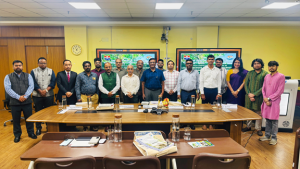
The inaugural session on the first day was presided by Prof. (Dr.) Arup Poddar, Professor of Law, NUJS. The welcome address was delivered by Shri Raja Chakraborty, Registrar, NUJS. Shri Manish Jain, IAS, Additional Chief Secretary, Forest Department, West Bengal, attended as Chief Guest and Shri Sandeep Sundriyal, IFS, Principal Secretary and PCCF & HOFF, Forest Department, Government of West Bengal, graced the occasion as Guest of Honor. Dr. M.P. Chengappa introduced the course to the delegates. This was followed by sessions addressed by Prof. (Dr.) Arup Kumar Poddar on the public trust doctrine and wetland conservation, and Prof. (Dr.) M.K. Ramesh, who joined online to trace the evolution of the legal framework governing wetlands in India. The post-lunch sessions were addressed by Dr. Vijay Kishore Tiwari, and Dr. Atul Alexander, who together discussed international environmental law, the Ramsar Convention, the Climate Change Convention, and the emerging jurisprudence of the International Court of Justice on wetland conservation. The day concluded with a session by Prof. (Dr.) Sandeepa Bhat B. on the international environmental law principles applicable to the protection of the human environment.
The second day opened with two sessions by Adv. Ritwick Dutta, who discussed the legal framework governing wetlands and sustainable management, followed by a problem-solving session built around live environmental projects. Prof. (Dr.) Sairam Bhat joined online for a brainstorming session on governance models and strategies for the better protection of wetlands. Prof. Ujal Kumar Mookherjee then spoke on the ecocentric approach to environmental governance. The day proceeded with a session by Prof. (Dr.) Sanjit Kumar Chakraborty on access to environmental justice, and closed with a session by Dr. M.P. Chengappa on sustainable wetland conservation.
The third day was devoted to a field visit to the East Kolkata Wetlands, giving the officers a first-hand understanding of the ecological and legal issues discussed through the week. On return, a session chaired by Dr. M.P. Chengappa examined judicial pronouncements on the protection of wetlands, covering Supreme Court, High Court, and National Green Tribunal cases, along with presentations by researchers on wetland conservation and management. The day closed with a session presided over by Ms. Ankita Chakraborty, featuring Ms. Kankana Das and Ms. Bonani Kakkar, who spoke on the role of NGOs in wetland protection and management.
The fourth day began with a session by Smt. Dr. Padma Mohanty, IFS, on a case study of wetland-community participation and management under the PPP model. Mr. Saibal Dasgupta, Former Hon’ble Expert Member, National Green Tribunal, spoke on the role of the NGT in forestry and environmental issues. Prof. Vaneeta Patnaik then discussed the scope for applying the CSR fund for the management and governance of wetlands in India. This was followed by a session on environmental litigation vis-à-vis wetland protection by Smt. Dhruba Das Gupta, and a session on sustainable use of wetlands by Dr. Mercy Khaute. The day concluded with a session by Adv. Santanu Chakravarty on litigation strategy in environmental governance.
The final day encapsulated the discourse of the week. Smt. Roshni Sen, IAS, Addl. Chief-Secretary, Government of West Bengal opened the day by sharing her experience on the sustainable management of wetlands. Prof. (Dr.) Sarfaraz Ahmed Khan then addressed the new criminal laws and environmental crimes, followed by a session on the use of forensic science in environmental crime by Dr. Ankit Srivastava and Dr. Tanurup Das, chaired by Dr. Surja Kanta Baladhikari. Prof. Gnanavi Bopaiah spoke on the role of community management in biodiversity conservation. The concluding interaction with the delegates on evolving better action plans for conserving and protecting wetlands in India was led by Dr. M.P. Chengappa. The valedictory session was presided over by Prof. (Dr.) Arup Poddar, Professor of Law, NUJS. The session closed with the vote of thanks and collection of feedback from the delegates.
The Training Programme, overall, has been a rich learning experience. With resource persons drawn from the judiciary, academia, government, and civil society, the deliberations offered a legal, administrative, and practical outlook on wetland conservation and sustainable management, equipping the officers with tools to address these issues in their respective jurisdictions.
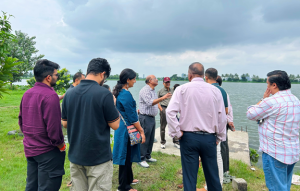
Field Visit to East Kolkata Wetlands


 Users Today : 484
 Users Last 7 days : 3603
 Total Users : 33508