

The West Bengal National University of Juridical Sciences (NUJS) was established under the West Bengal National University of Juridical Sciences Act, 1999 (West Bengal Act IX of 1999). The university is recognised under sub-section 2 (f) and section 12(b) by the University Grant Commission. The BA LL.B and BSc. LL.B is affiliated with the Bar Council of India. Outside of graduation courses, the University offers M.Sc. in forensic sciences and 1 year Master of Laws (LL.M) in 5 specialisations. The University offers Ph. D. courses and even Post-doctoral LL.D. opportunities to academicians and scholars. The Hon’ble Chief Justice of India is the Chancellor of the University and Chairman of its highest governing body -the General Council. In its relatively short existence, NUJS has firmly established itself as one of India’s premier national law universities.
NUJS ranked 4th in NIRF India Ranking 2024 under the Law category. It has consistently been ranked amongst India’s top law schools in reviews conducted by Outlook India, Mint and LexisNexis Halsbury’s Law Monthly. The University received the prestigious SILFMILAT INSTITUTIONAL EXCELLENCE AWARD 2015, Star Ananda Siksha Samman 2023, and also been ranked in Top 100 in The World University Rankings for Innovation (WURI).
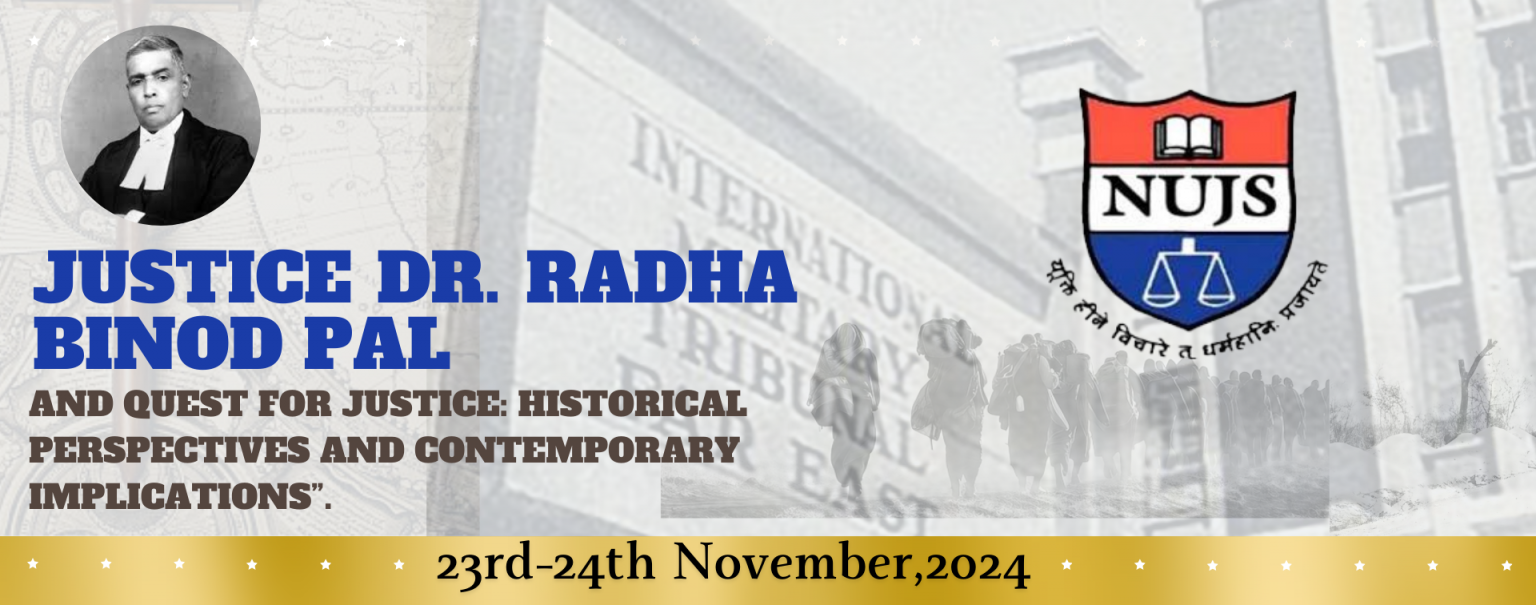
The West Bengal National University of Juridical Sciences (WBNUJS) proudly announces International Conclave on Relevance of Judge Dr. Radha Binod Pal’s Dissent in International Law.
This conclave aims to explore and critically examine the profound influence of Justice Pal’s jurisprudence on the development of international law, with a particular focus on his dissenting opinion at the Tokyo Trials and its implications for contemporary legal thought. Justice Radhabinod Pal’s dissenting opinion at the International Military Tribunal for the Far East (Tokyo Trials) remains one of the most compelling critiques of international criminal justice. Justice Pal contended that the trials were a manifestation of Victor’s justice, questioning the legitimacy and impartiality of the proceedings. He argued that the charges of crimes against peace and crimes against humanity were applied retroactively and selectively, undermining the fundamental principle of legality (nullum crimen sine lege). Pal’s dissent highlighted the necessity for a consistent and unbiased application of international law, advocating for a legal framework that could transcend political interests and uphold international criminal justice. His dissent challenged the prevailing legal orthodoxy and laid the groundwork for critical discourse on the nature and purpose of international criminal law.
Critical theory in jurisprudence offers a vital lens through which the structures, practices, and underlying assumptions of international criminal law can be interrogated and often facilitates a more nuanced understanding of justice and accountability in the global context by challenging traditional narratives and exposing power dynamics. It underscores the importance of historical context, cultural perspectives, and socio-political influences in shaping legal norms and practices. In international criminal law, the theory encourages a re-examination of established doctrines, advocating for more equitable and inclusive approaches to justice that resonate with the diverse experiences of global communities. Justice Radhabinod Pal’s contributions to the critical theory of jurisprudence in international criminal law are profound and enduring. His dissenting opinion at the Tokyo Trials is a seminal critique of the established legal norms, highlighting the inherent bias and power imbalance within the international legal system. Through his rigorous critique, Pal advanced a more equitable and inclusive vision of international criminal jurisprudence, emphasising the need for a legal framework that genuinely reflects the diverse realities and perspectives of the global community.
Justice Radhabinod Pal’s perspectives resonate strongly with Third World Approaches to International Law (TWAIL) ideology. TWAIL critiques the imperialist, colonialist and neo-colonialist underpinnings of international law, advocating for a more inclusive and representative legal system that addresses the historical injustices and ongoing marginalisation of the Global South. Pal’s insistence on impartiality and his critique of Victor’s justice align with TWAIL’s call for a restructured international legal order that genuinely reflects the interests and voices of developing nations. His work prefigures many of TWAIL’s core tenets, emphasising the need for international law to be a tool of emancipation rather than domination.
The legacy of Justice Radhabinod Pal continues to influence modern international criminal law, challenging practitioners and scholars to reflect on issues of fairness, impartiality, and the enduring effects of colonialism. His dissent at the Tokyo Trials serves as a crucial reminder of the potential for international law to be wielded as an instrument of global justice rather than power. By examining Pal’s impact, this conclave aims to inspire a reinvigoration of the principles of equity and justice in international criminal law. It is hoped that the discussions and insights generated will contribute to the evolution of a more just and inclusive international legal system.
This International Conclave on Justice Radhabinod Pal and His Impact on International Law, is organised by Chair on Justice Dr. Radha Binod Pal, sponsored by Govt. of West Bengal. WBNUJS, aspires it to be a pioneering event in international law scholarship. By bringing together a diverse array of scholars and practitioners, the conclave will facilitate a rich exchange of ideas and perspectives, fostering a deeper understanding of Justice Pal’s contributions and relevance to contemporary legal challenges. This event promises to be a significant milestone in the ongoing dialogue on international law and justice, honouring the enduring legacy of Justice Radhabinod Pal.
We invite researchers, policymakers, academicians from law, social science, and other allied areas to submit papers aligned with the conference themes. These research papers shall be published as a comprehensive book by a reputed publisher, as a blueprint for studying the influence of Justice Radhabinod Pal’s jurisprudence on the development of international law, particularly his dissenting opinion at the Tokyo Trial, and its implications for contemporary legal theory and practice.
The paper must be written in British English, typed using Times New Roman (Normal style, Font size 12, Line Spacing 1.5) and in MS-Word. Page size should be A4, single column with 2.5 cm (1 inch) margin on all sides with single line spacing. All pages of the manuscript (including Tables and Figures) must be numbered.
Each Submission should be accompanied with Author/ Author’s Bio (Mentioning the name of the author, designation, permanent/corresponding address, contact details, and Primary Email ID), Declaration of Originality.
Word Limit: 5,000–7,000 words (excluding footnotes)
Citations: Bluebook (20th edition) citation style.
Similarity below 10%
The manuscripts is to be renamed as <Name of the first author _ Title of the Paper>
Submission: Papers should be submitted in Word format to https://forms.gle/tbD5up8MTbLRmDBV8
Selected papers will be considered for presentation in the conclave and publication in a Book bearing ISBN Number with a reputed publisher, with other invited resource persons.
The final decision on publication and presentation depends on the blind review of the full paper and the quality of the research work.
The option of co-authorship is available for up to two authors. If selected for presentation, both the authors will have to register for the Conclave individually.
The submission must be the original work of the authors.
Any form of plagiarism will lead to direct rejection.
The decision of the organizers in case of conflict of interest shall be final.
The selected presenters, basis of the papers submitted shall be intimated over email for processing the registration fee.
Research Scholars: 2000 INR + 18 % GST (using the SBI Challan Link)
Academicians / Teachers: 4000 INR + 18 % GST (using the SBI Challan Link)
The SBI Challan Link shall be shared with the selected presenters by email.
All Registration Fees paid shall be non-refundable.
The university will be unable to provide accommodation to all participants due to space constraints at the campus. However, accommodation may be provided to the author and/or co-author (maximum 10 in number) whose papers will be selected for presentation.
For details on Accommodation, you may contact:
Mr. Biswajit Bose
Research Assistant,
The West Bengal National University of Juridical Sciences, at +91 9830089116
| EVENTS | IMPORTANT DATES |
|---|---|
|
Full Paper Submission Deadline |
20th October, 2024 |
|
Intimation of Selection |
30th October, 2024 |
|
Last Date of Registration |
5th November, 2024 |
|
International Conclave on Relevance of Judge Dr. Radha Binod Pal’s Dissent in International Law. |
23rd- 24th November, 2024 |
FOR PAPER SUBMISSION & REGISTRATION:
Mr. Nirbindu Banerjee: 7001393010/9800102802
Mr. Maneesh Kumar Chauhan : 7001335297
FOR ACCOMODATION :
Mr. Biswajit Bose : 9830089116
FOR ANY QUERY/ASSISTANCE : internationaloffice@nujs.edu


 Users Today : 484
 Users Last 7 days : 3603
 Total Users : 33508
© 2022 The West Bengal National University of Juridical Sciences, Kolkata | All rights reserved